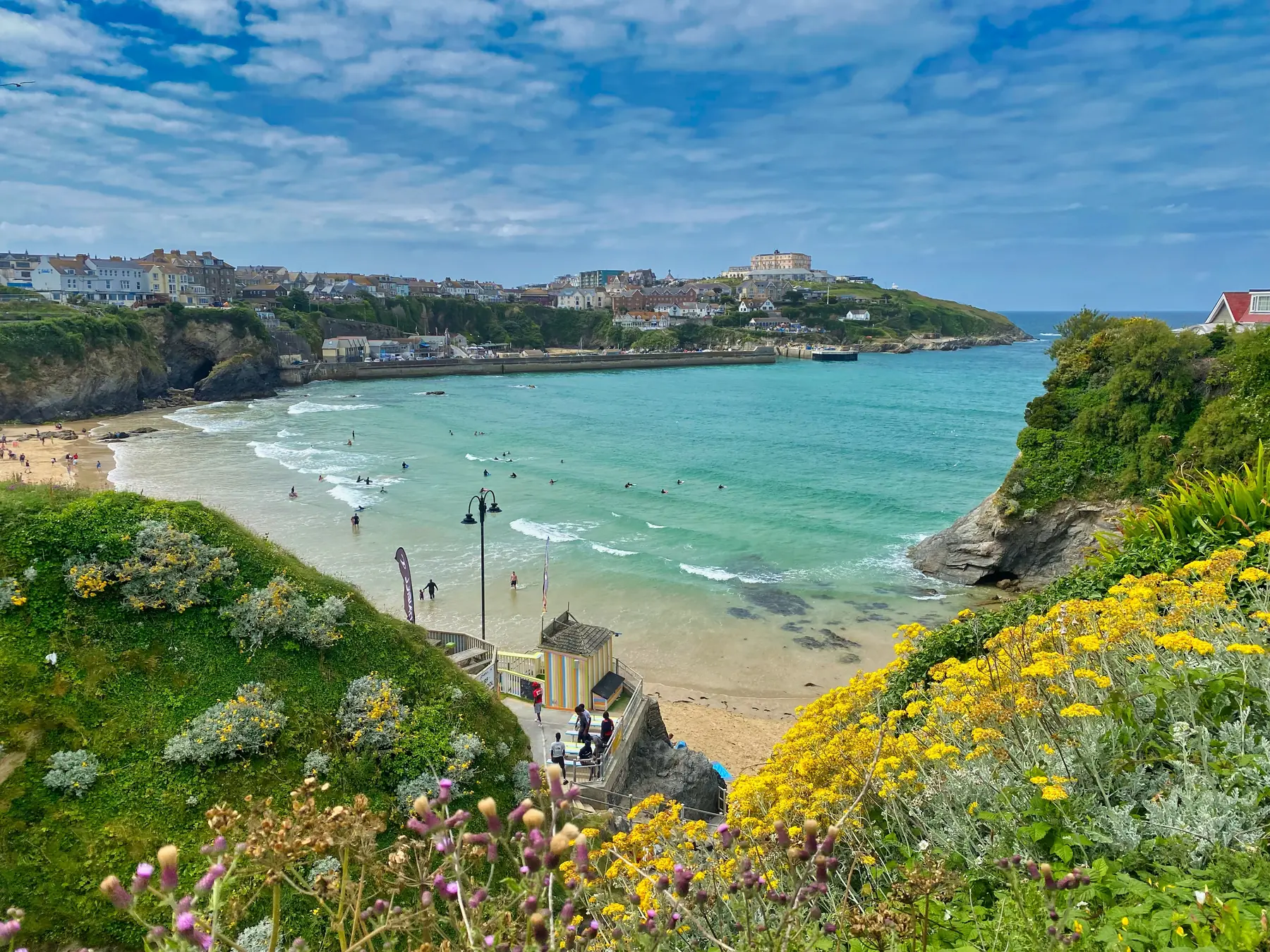
Newquay calls itself the surf capital of Britain, and while several other places would argue, the town has the strongest claim: the best-known break in the country at Fistral, the largest concentration of surf schools and shops anywhere in Britain, a professional competition every August, and a coastline that faces the Atlantic in a way that produces rideable waves on most days of the year.
It is also one of the easiest places in the world to learn. The teaching industry here is fifty years old, the beach breaks are forgiving, and a two-hour group lesson will have most reasonably fit adults standing up.
Newquay faces roughly west-north-west into the open Atlantic. Swell generated by low-pressure systems thousands of kilometres away arrives with nothing in the way, which is why a calm-looking sea can still have waves in it.
Two things then decide whether it is any good. Wind — an offshore wind, here meaning easterly, holds the waves up and makes them clean; an onshore westerly flattens and disorders them. And tide, which on some breaks makes a large difference.
The practical upshot for a visitor is that the surf changes hour to hour, and a blown-out morning can become a good afternoon.
Two hours, in a group, with a wetsuit and a soft-topped foam board provided. The first half hour is on the sand — safety, the whitewater, how to pop up — and the rest is in waist-deep white water catching broken waves. Almost everyone stands up in the first session.
Schools generally take adults and children from about age eight in group lessons, with private and family lessons available. You do not need to be a strong swimmer to do a beginner lesson in white water, but you should be comfortable in the sea.
Not usually at Fistral on a big day. Schools move to whichever beach has the right conditions — often Towan or Great Western in the town, Watergate Bay, or the sheltered end of Fistral when it is small. That flexibility is one of the advantages of learning here.
Most schools run progression courses and improver sessions, and several offer multi-day courses. Hiring a board and going out on your own after one lesson is how people get into trouble; a second and third session with an instructor is much the better use of the money.
Beginners: Towan and Great Western in the town, sheltered and small; Watergate Bay on a moderate day.
Improvers: Watergate Bay, Crantock, Perranporth, and Fistral on a small clean day.
Experienced: Fistral proper, which can be powerful and crowded; Crantock’s river-mouth banks; and, further afield, the reefs and points along the coast.
The Cribbar: the reef off Towan Head that produces genuinely large waves a handful of times a year. It is a big-wave spot for a very small number of people and it is watched from the headland by everyone else. Do not confuse it with the beach break.
Wetsuit — essential year-round. Cornish water is cold, and even in August most people wear one. Winter needs a thicker suit with boots and often a hood; hire shops stock the right thickness for the season.
Board — a soft-top for learning, hired from any school or shop. Hard boards are for people who know what they are doing.
Everything can be hired in Newquay, from every third shop on Fore Street and at the beaches. There is no need to bring anything.
Summer has the warmest water, the smallest waves, the most lessons and the most crowded line-ups. It is the right time to learn and the wrong time to expect quality surf.
Autumn is the best season: Atlantic swells return, the water is still relatively warm — sea temperatures peak in late August and September — and the crowds have gone.
Winter has the biggest and cleanest waves and the coldest water. It is for the committed and the properly suited.
Spring is variable, with cold water and improving weather.
This is the part that matters.
Rip currents are the main hazard on any beach here. They form where water returning seaward finds a channel, typically beside reefs, river mouths and sandbanks. If you are caught in one, do not try to swim against it: swim parallel to the beach until you are out of the flow, or float and signal.
Swim and surf between the flags where the RNLI is patrolling. The black-and-white flags mark the area for boards; the red-and-yellow flags mark the swimming area, and boards are not allowed between them.
Never surf alone, especially outside the lifeguarded season.
Know your limits. Fistral on a big day is not a beginner’s beach, and the number of rescues there each summer reflects how many people find that out the hard way.
Newquay’s water sports have expanded well past boards. Coasteering — scrambling, swimming and jumping along the base of the cliffs in a wetsuit and helmet — is the town’s other signature activity. Sea kayaking and paddleboarding run from the sheltered coves and up the Gannel. Wave-runner safaris and sea safaris go out to look for seals and dolphins. And there is a sauna above the beach at Watergate Bay for afterwards, which after a February session is not a luxury.
The competition and festival in early August is the fixed point of Newquay’s surf calendar: a professional surf contest at Fistral and a music festival above Watergate Bay, with tens of thousands of people in town for the week.
The surfing is free to watch from the beach and the standard is high. The town is completely full, accommodation goes months ahead, and if you are not going, plan around it.
Free parking at Fistral, Pentire Headland and Mount Wise; the beach car parks fill early in summer.
Check the forecast — surf forecast sites give swell height, period and wind direction, and the local schools and shops will tell you honestly whether it is worth going out.
Lessons book up in the school holidays. Book ahead.
Changing. Most schools have facilities; otherwise the car park and a towel, like everyone else.
Worth knowing, because it explains the shape of the place. Surfing arrived here properly in the early 1960s, brought by Australian and South African lifeguards working the Cornish beaches, and by a handful of local pioneers making their own boards. Fistral was the natural centre: a big, consistent, west-facing bay with room for everyone.
The industry grew around it — board shapers, then wetsuit makers, then surf schools, then the shops and the clothing brands. By the 1980s Newquay had become the centre of British surfing, and by the 1990s the town’s summer economy had been reshaped around a young, transient, board-carrying visitor.
That is also where the town’s stag-and-hen reputation came from, and it is largely historic: the trade has shifted back towards families and towards a more serious water-sports economy, with coasteering, kayaking and paddleboarding alongside the surfing.
If you progress past the white water, the unwritten rules matter and nobody will explain them politely twice. The surfer closest to the breaking part of the wave has priority. Do not paddle for a wave someone is already riding. Do not paddle straight through the take-off zone — go round. Hold on to your board rather than letting it go, because a loose board is the main way people get hurt. And if you are learning, stay out of the crowded peak and use the shoulder.
Fistral gets busy in summer and the line-up can be competitive. Watergate Bay and Perranporth have more room.
Very. It has more surf schools than anywhere in Britain, forgiving beach breaks and instructors who teach complete novices every day.
Wherever the school is running that day — usually Towan, Great Western or Watergate Bay rather than Fistral on a big swell.
Autumn, for consistent swell and relatively warm water. Winter for the biggest waves.
Yes, year-round. The sea here is cold even in August.
A reef break off Towan Head that produces very large waves a few times a year. It is an expert big-wave spot, not a beach break.