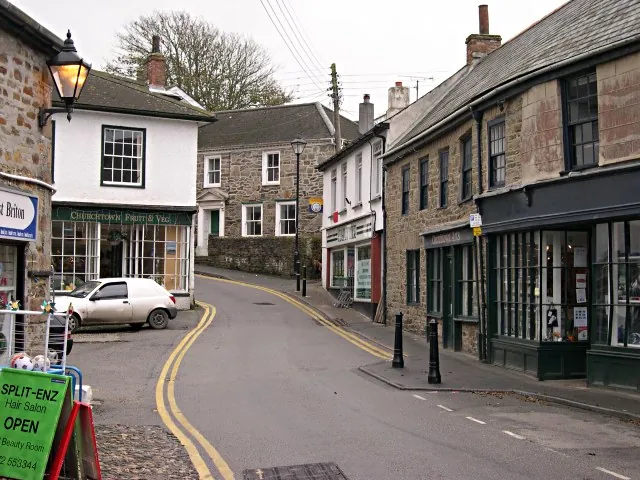
St Agnes is a village and civil parish on the north coast of Cornwall, and what you come for is the wreckage of an industry. Copper, tin and arsenic were mined here from prehistoric times until the 1920s — at their height about 100 mines employed 1,000 miners — and the engine houses they left stand on the cliff edge above the Atlantic. Much of the Cornwall and West Devon Mining Landscape, a World Heritage Site, lies inside the parish, whose population was 8,591 at the 2021 census.
The straight-line distance is 14.5 km. The coast has been designated St Agnes Heritage Coast, protected nationally since 1986; the parish also takes in Blackwater, Mithian, Mount Hawke and Porthtowan.
The shape of a day here repeats itself: park above the sea, walk down to a cove, walk back up. It holds at Trevaunance Cove below the village and at Chapel Porth, and it is what reviewers raise most.
Wheal Coates carries 4.9 from 824 Google reviews, the highest-rated thing in the parish. Mining ran on the site between 1066 and 1540 and again from 1802 into the 20th century; what survives are engine houses built in the 1870s to crush ore, run a calciner and pump water, all now National Trust.
Reviewers treat it as a walk rather than a monument. A visitor in June 2026 called it “Great examples of post industrial Cornwall” and described how you “come across a blow hole in the cliffs which will create a spectacular smoking effect when there’s a decent swell in the sea”. Footing is the caveat: a visitor in July 2026 wrote, “Fantastic views, car parking close by. Some footpaths are a little rocky so be careful,” and another that month, “some of the paths are very narrow and steep.”
It is not the only site. Blue Hills Tin Streams, in the Jericho valley, still works tin and puts on demonstrations. In the village, Stippy Stappy is a row of 18th-century cottages on a very steep incline.
Trevaunance Cove, 4.7 from 1,146 Google reviews, is the village beach: small and sandy, with lifeguards and adequate parking, and a Site of Special Scientific Interest for its two ore-bearing mineral veins. The hill is the catch. A visitor in July 2026 wrote, “Look it’s a great little cove but if you struggle with mobility it’s a challenge to and from beach”. Another that month described a “Slow walk back up the hill to the village on a very hot day this week”. A third called it a “Nice pebley beach”; other visitors call the same cove sandy.
Chapel Porth, 4.8 from 924 Google reviews, has a harder constraint. A visitor in June 2026 warned, “make sure to check tide times as when the tide is high you can’t get onto the beach,” adding that it “has a toilet, cafe and parking is very close to the beach, but wouldn’t be good for disabled people as to get onto the beach there are big stones.” Check the tide before committing to the drive.
Trevellas Porth is rocky and popular with divers and fishermen, but not recommended for swimming. Porthtowan, in the same parish, has a sandy beach.
St Agnes Beacon takes its name from the Cornish Bryanick, which may mean pointed hill; “beacon” is an Anglo-Saxon word for a summit used for a signal fire, and during the Napoleonic Wars a guard was stationed here to watch for French ships and light one on sight. It is regarded as the most prominent feature of this coastline, and holds 4.8 from 137 Google reviews, a small sample. The Beacon and the cliff tops around it are one of the last remnants of a huge tract of Cornish heathland, turning yellow and purple with gorse and heather from late summer on.
The heritage coast as a whole carries 4.8 from 6,724 Google reviews, and a visitor in July 2026 summed up what a walk here needs: “Fantastic coastal trails, not difficult for a hike, normal walking footwear would suffice. Roads to certain start points can be very narrow and unsuitable for wider vehicles like motorhomes.” That matters if you are driving something wide out of Newquay. It fills locally in season, too — a visitor in June 2026 described a “small beach which gets swamped with locals when school ends”.
The sea here has repeatedly refused to hold a harbour. Between 1632 and 1709 the Tonkins, lords of the manor of Trevaunance, spent the family legacy on three attempts, the last assisted by Henry Winstanley; it was washed away in 1705. A harbour built by an unrelated party in 1710 was levelled by the waves in 1730. The one built in 1798 lasted longest — it exported copper ore, imported South Wales coal for the mine smelters, and from 1802 carried a pilchard fishery that peaked in 1829 and 1830 — until its wall collapsed in a storm in 1915/16. Only remains of it exist now, and a visitor in June 2026 caught them in weather: “Tide was in and the waves looked spectacular crashing onto the jetty. There’s a small beach when it’s out.”
Mining ended in the 1920s, and by the 1950s the area had very little industrial commerce. It became a bedroom community for workers in Newquay and Truro, a retirement area and a holiday spot, with the mining history itself part of the draw. St Agnes Parish Museum covers that history, including a 700-pound (320 kg) leatherback turtle.
By road, the village lies on a main road between Redruth and Perranporth. Go Cornwall Bus runs through the village, but no route linking St Agnes to Newquay is established here. Treat driving as the default and confirm any bus locally.
There is no station. St Agnes had one on the Perranporth line from 1903 until 1963. The nearest stations are Redruth and Truro, neither on the Newquay side.
For touring, the St Agnes Beacon Caravan and Motorhome Club campsite is listed 15.7 km from the Newquay centre at 4.7 from 180 reviews. Once you are in the parish the rest is car-free: there are paths for coastal walks and cycling, and Chapel Porth to Wheal Coates is the stretch reviewers describe walking most.
The village and what is around it, at walking scale.
Open any of them in Google Maps for directions and current opening.
Attractions, prices and availability in Newquay
These come from GetYourGuide's booking widget, which sets their cookies in your browser. Consent to load it and see the attractions and prices.
Background on St Agnes draws on its Wikipedia article, text there being available under CC BY-SA 4.0.