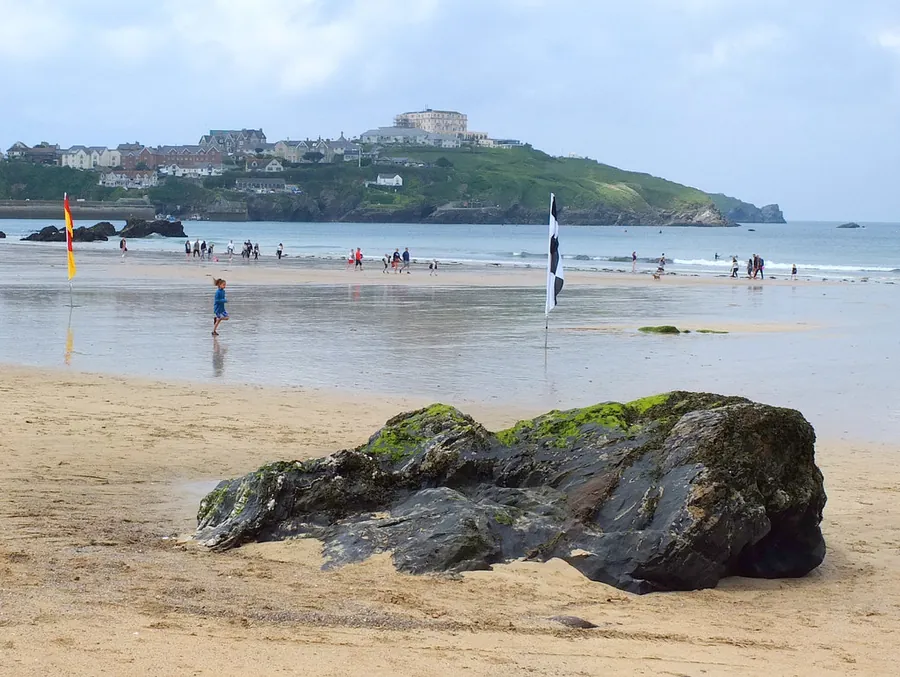
Great Western Beach is a sheltered sandy cove immediately below Newquay town centre, between Towan to the west and Tolcarne to the east, and it takes its name from the Great Western Railway — whose arrival in 1876 turned a small pilchard port into a resort.
The railway station is a few minutes’ walk above it, which is exactly why the beach is called what it is.
Sand, backed by cliffs on both sides, with a large expanse exposed at low tide and a much smaller one at high water.
It is one of the town beaches, meaning it is a couple of minutes from shops, pubs and chip shops, which is its principal advantage over the bigger and better-known Fistral on the other side of the headland.
The water is clear, the sand is clean, and the cliffs give it a more enclosed and sheltered feel than the exposed Atlantic beaches.
Surf: modest by Newquay standards — the town beaches face north into Newquay Bay rather than west into the Atlantic swell, so the waves are smaller and the conditions gentler. That makes Great Western a learners’ beach rather than a serious surf spot, and surf hire and lessons operate from it in season.
Lifeguards patrol in season.
The town beaches join up. From Great Western you can walk on the sand west to Towan — with its island house on a rock, joined to the mainland by a private suspension bridge, which is Newquay’s oddest building — and east to Tolcarne and on to Lusty Glaze.
That connected stretch of sand at low water is the best thing about staying in central Newquay.
A café on the beach, open in season, and the Great Western Hotel above it, which has the view.
Toilets and beach hire.
Fish and chips from the town, eaten on the sand, is the standard local move and the beach is well set up for it.
Free, open at all times.
Access: the beach is reached by steps and a ramp from the cliff path above; check for the current arrangement, as access here has been affected by cliff works in the past.
Parking: town car parks above, charged; on-street parking in central Newquay is difficult in summer.
Tide: the beach is substantially bigger at low water. At high tide it can be reduced to a narrow strip.
Busy: it is a town beach in Newquay in August. Early morning is a different place.
Towan Beach, the next cove west, with the Blue Reef Aquarium on the promenade above it.
Tolcarne Beach, east.
Fistral Beach, on the far side of the headland — the big Atlantic surf beach, ten minutes’ walk.
Newquay Harbour, working and small, below the town.
The Huer’s Hut on the headland, where a lookout once watched for pilchard shoals and shouted the alarm to the boats.
After the Great Western Railway, whose arrival in 1876 created Newquay as a resort. The station is a few minutes above the beach.
For learning, yes — the town beaches face into the bay and get smaller waves than Fistral. Hire and lessons run in season.
Yes, in season.
Yes, at low tide — the town beaches connect along the sand from Towan through to Lusty Glaze.
It is directly below the town centre, a couple of minutes from the shops.