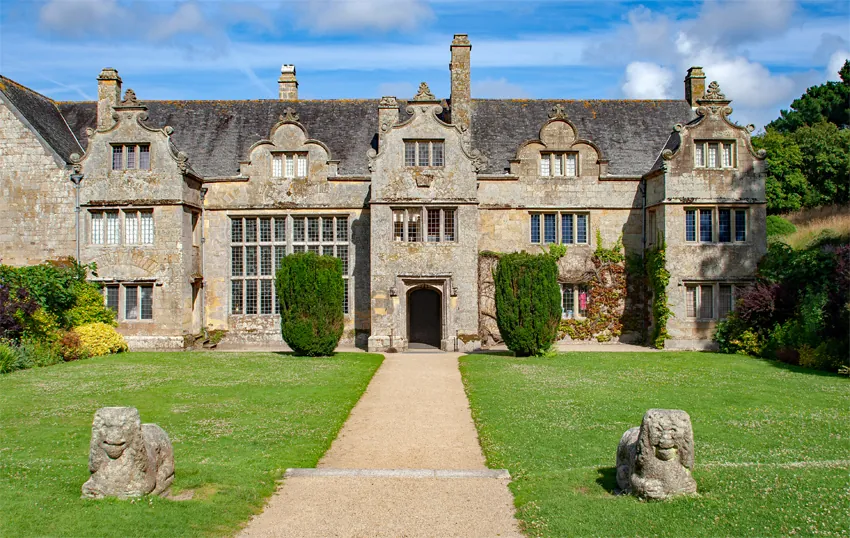
Trerice is a Tudor manor house at Kestle Mill, four kilometres east of Newquay, and it is one of the more unexpected things in this part of Cornwall: a small, complete, Grade I listed Elizabethan house down a lane, surrounded by gardens, five minutes from the surf shops.
The National Trust has owned it since 1953.
The present house was built around 1573 for Sir John Arundell, of a family that had held the manor since the fourteenth century.
Its most striking feature is the east front: a facade with curved and scrolled gables in a Dutch manner rarely seen in England at that date, and a great window of 24 lights filling the end of the hall — 576 panes of glass, an extraordinary display of wealth at a time when glass was priced by the pane.
Inside, the Great Hall with its plaster barrel ceiling and the Great Chamber above it are the set pieces. The plasterwork is dated 1573 and is original.
The house is small by country-house standards — an hour covers it — and the Trust presents it lightly furnished, which suits it.
The family were Royalists in the Civil War. Sir John Arundell — “Jack for the King” — was the octogenarian who held Pendennis Castle at Falmouth through a five-month siege in 1646, surrendering only when the garrison had run out of food, and marching out with colours flying.
Trerice declined after the family line failed, was let as a farmhouse, and passed through a succession of owners before the Trust took it.
Large — larger than the house, and the reason to allow more than an hour.
An orchard of old Cornish apple varieties, which is the garden’s real distinction: local cultivars preserved here that exist in few other places.
A walled front court, lawns, a knot garden, and mixed borders. Visitors note that the floral displays are limited compared with the great Cornish gardens — this is not Trebah or Bodnant, and it does not try to be. What it has instead is quiet, structure and space.
Wildflower meadows, which in some years produce startling displays — purple poppies among them, with seed sold in the shop.
A kayles alley — an early form of skittles, played on a long alley — restored and playable. Along with the lawn games out on the grass, it is why the site works surprisingly well with children.
The Great Barn houses a small lawnmower collection, which is exactly as odd as it sounds and is genuinely interesting.
Admission charged; free to National Trust members.
Time: an hour for the house, one to two more for the gardens.
Facilities: café — well regarded — shop, toilets. Second-hand books.
Access: the ground floor of the house is accessible; the upper floor is up stairs. The gardens are largely level grass and gravel.
Opening: seasonal, and not every day out of high season. Check before travelling.
Parking: free on site, down a narrow lane.
Dogs: on leads in the grounds.
Kestle Mill, signposted off the A3058 east of Newquay — about ten minutes by road down narrow lanes.
Lappa Valley is five minutes away, and the two together make a good day for a family with a range of ages.
Newquay and its beaches are ten minutes west.
The present house was built around 1573 for Sir John Arundell, and it is Grade I listed.
The 24-light window filling the end of the Great Hall on the east front — 576 panes, an extraordinary display of wealth for 1573.
An hour for the house and one to two more for the gardens.
Better than expected — there is a playable kayles alley, lawn games and space to run.
No, it is seasonal and not open every day outside high season. Check before travelling.