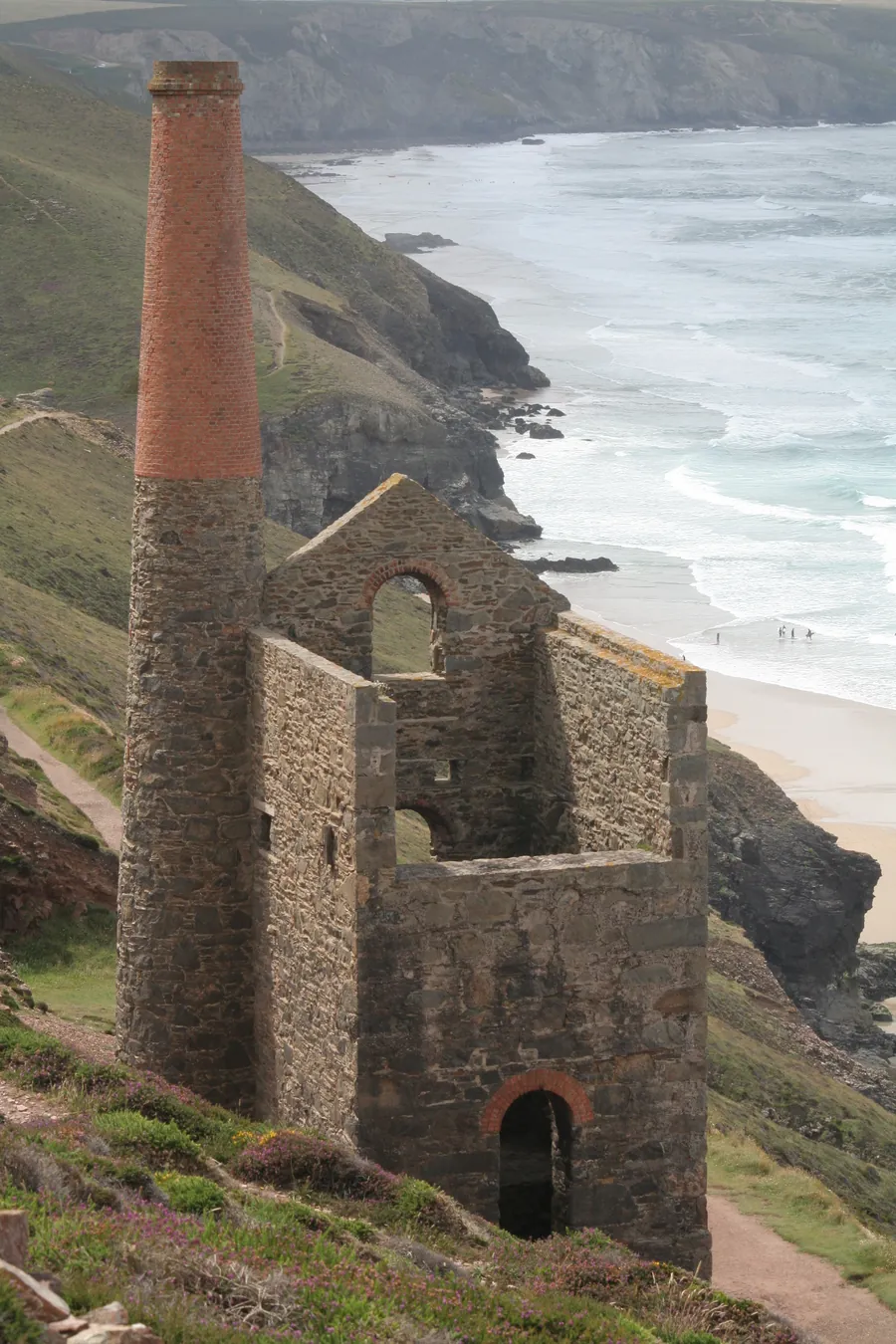
Wheal Coates stands on the cliffs between St Agnes and Porthtowan, sixteen kilometres south-west of Newquay, and it is the most recognisable industrial ruin in Britain: a granite engine house perched on a ledge halfway down a cliff, with the Atlantic below it and open moorland above.
It is a former tin mine, part of the Cornwall and West Devon Mining Landscape World Heritage Site, and the National Trust looks after it.
Towanroath Pumping Engine House is the famous one — the building on the ledge. It was built in 1872 to house a beam engine pumping water from the Towanroath shaft, which runs down to about 180 metres below, well below sea level.
Above it, at the clifftop, stand the whim engine house and the calciner — the whim wound the shaft, and the calciner roasted the ore to drive off arsenic before smelting. Arsenic was a by-product of Cornish tin and became valuable in its own right.
The mine worked intermittently from the 1690s, expanded in the 1870s, and closed for good in 1914. It was never very profitable.
Cornish engine houses have a standard form: a massive bob wall carrying the beam, a chimney at one corner, and thin side walls. The bob wall is the thick one facing the shaft, because it took the entire load of a rocking beam weighing many tons.
Wheal Coates was built where it was because that is where the shaft was, and the shaft was there because the lode was there. The picturesque siting is entirely accidental — an accountant’s decision that happens to have produced one of the great images of industrial Britain.
From the Chapel Porth car park (National Trust, charged, free to members), the path climbs north along the cliff for about a kilometre to Towanroath. It is the shorter approach and the more dramatic.
From the St Agnes Beacon car park above, it is a gentler descent across the moor.
The South West Coast Path runs through, and the walk from St Agnes Head south past Wheal Coates to Chapel Porth and on to Porthtowan is among the best coastal walks in Cornwall.
St Agnes Beacon, 192 metres, is a twenty-minute climb from the top car park and gives a view over a large part of Cornwall — both coasts on a clear day.
Underfoot: the paths are rocky, narrow and steep in places, and visitors say so. Proper shoes.
Along the cliff there is a blowhole which, in a decent Atlantic swell, produces a plume of spray and spume from the cliff face. It is worth looking for on a rough day and is one of the better things on the walk.
The beach below is a narrow sandy cove at low tide that disappears completely at high water — check the tide before going down. It is lifeguarded in season, popular with surfers, and the beach café is locally famous for the hedgehog: a cone of ice cream rolled in clotted cream and hazelnuts.
Free and open at all times. Parking is charged at Chapel Porth and at St Agnes Beacon; free to National Trust members. Both are small and fill early.
Time: an hour to walk to the engine house and back; half a day for the full coast walk.
Facilities: café and toilets at Chapel Porth, seasonal.
Safety: the ground is undermined by old workings, some shafts are capped and some are not, and the cliff edge is unfenced. Stay on the paths.
Access: not accessible — the paths are steep, rocky and narrow.
Best time: sunset, when the engine house is between you and the light.
Tin, primarily, with arsenic recovered as a by-product. The mine worked intermittently from the 1690s and closed in 1914.
Yes, the site is free and open. Parking at Chapel Porth and St Agnes Beacon is charged and free to National Trust members.
About a kilometre each way from Chapel Porth, on rocky and steep cliff paths.
No — the approaches are steep, narrow and uneven.
Sixteen kilometres south-west, about twenty-five minutes by road.