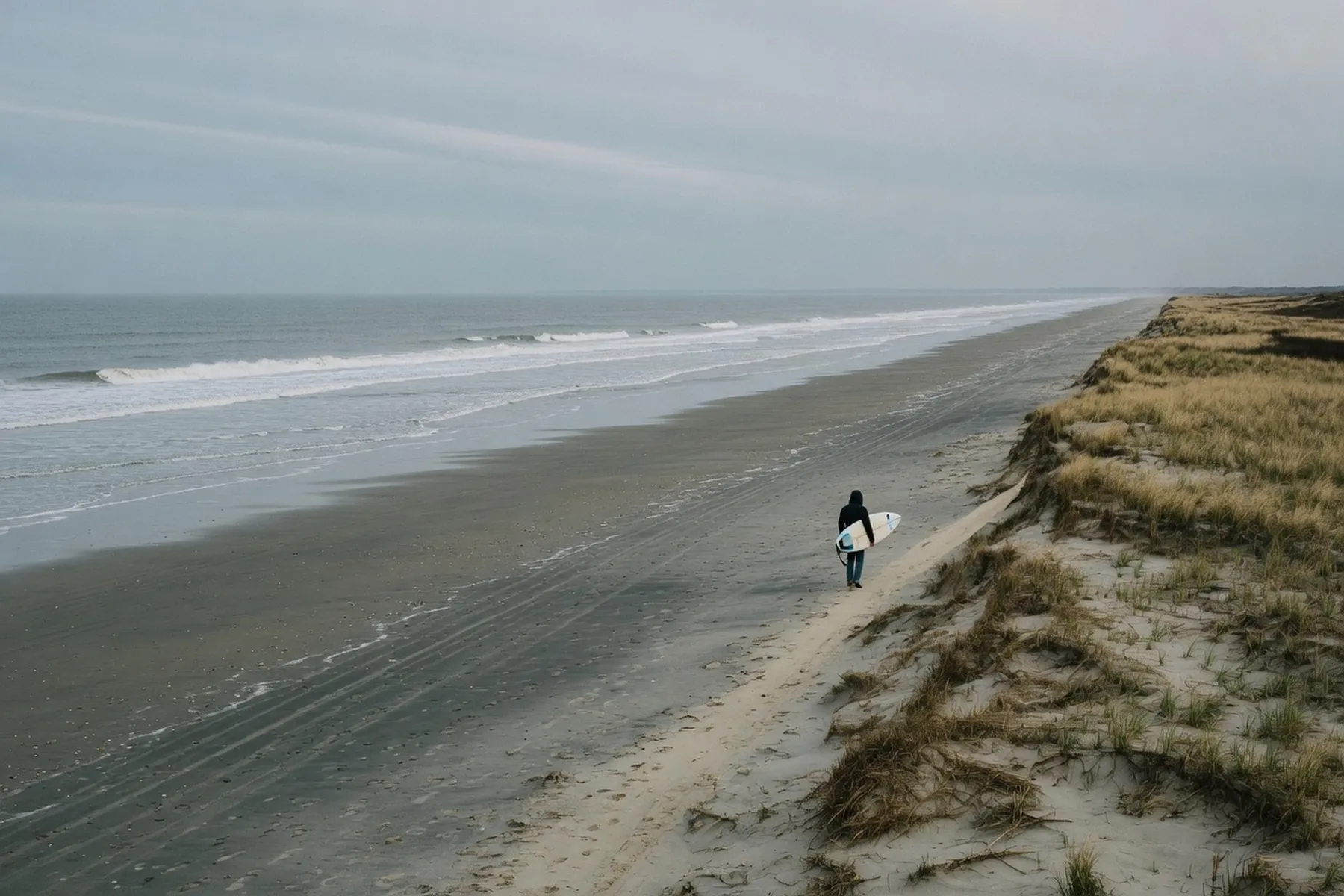
Fistral is the beach people mean when they say Newquay is a surf town. It lies on the west side of the town, open to the Atlantic between two headlands, and most days of the year there are waves working across it. Everything else on the sand — the surf school, the beach bar, the long car park above the dunes — exists because of that water.
The beach operator sells Fistral as the Home of British Surfing, and the label is not just a slogan. The beach faces the prevailing swell with few offshore obstructions, which is why it produces rideable waves through much of the year. It hosts Boardmasters, part of the World Surf League qualifying series, along with the English Nationals and the Surf Life Saving Club championships. On big days, Cornwall’s big-wave break, the Cribbar, runs off the north end and is surfed by a handful of people who train for it.
The International Surfing Centre was built in 2003 in the natural amphitheatre the two headlands form around the sand. It holds restaurants, shops and surf hire, and it is the building most first-time visitors aim for.
Fistral runs roughly north to south between Towan Head and East Pentire, with the Gannel estuary tucked behind its southern shoulder. The north end, under Towan Head, is the small cove known as Little Fistral. The south end rises toward the headland and the path to Crantock.
If you are driving, the beach is a short trip from the town centre but awkward on foot if you are carrying boards and a wetsuit. Walkers come down from the Pentire side or along the coast path; drivers go to one of the two car parks described below. The surfing guide sets out which break suits which ability.
There are two car parks and they are not the same thing, which is where most online write-ups go wrong.
South Fistral car park, on Pentire Road, TR7 1QS, is one of two public car parks owned by Newquay Town Council. It has 134 spaces and is pay-and-display. Tariffs as of 1 June 2026, from 1 April to 31 October, run 9am to 4pm every day: up to one hour is £1.20, one to two hours £2.30, two to four hours £5.00, and a full 24 hours £6.30. Longer stays are £15.70 for a week, £59.50 for a month, £281.00 for three months and £318.50 for six. Between 4pm and 9am parking is free all year, and from 1 November to 31 March the whole day is free. The council car park page is the document to check, because tariffs move.
Blue badge holders pay the ordinary fee unless the vehicle is on Cornwall Council’s exemption or adapted-vehicle scheme; displaying a badge and paying gets one extra hour, so paying for two hours parks for three.
The car park on the sand itself, beside the International Surfing Centre on Headland Road, TR7 1HY, is the private Fistral Beach car park, run by the beach operator rather than the council. Its tariff is not published on any page that can be checked in advance, so check the board or the machine on arrival. It fills on good surf days, and in summer it is often full by mid-morning. The East Pentire headland car park above the coast path is managed separately by NPC, with its own terms for adapted vehicles.
Fistral is a wide stretch of sand backed by low dunes, with the amenities gathered where the surf school, the shops and the food stand, toward the southern end near the car park. The north end is quieter and emptier at high water, when the rocks under Towan Head hold the sand back.
Fistral Beach Surf School & Hire describes itself as the only surf school and hire on Fistral Beach. It operates from the International Surfing Centre, open all year, with changing rooms, hot showers and secure storage on site. Lessons range from beginner, improver and intermediate group sessions and a bodyboard group through private lessons, stag and hen groups, corporate bookings, school sessions and a weekly surf club for children, plus beginner and progressive surf weekends. Hire covers foam and hard surfboards, bodyboards, paddleboards, wetsuits and accessories. Phone 01637 850 737.
Fistral has an ordinary twice-daily tide. Surf schools and surfers describe mid-tide as the most dependable working conditions, but the exact times move every day, so read a tide table — the surf school and the beach noticeboards post them — before planning a surf or a visit that depends on low water.
That matters particularly for Little Fistral. The small cove under Towan Head only really opens up around low tide; at high water there is little sand to sit on.
Fistral has seasonal RNLI lifeguard cover through the warmer months. The exact dates and hours change by season, so check the RNLI page or the on-site board rather than relying on a figure from another year. The flags do the day-to-day work: red and yellow marks the swim and bodyboard zone, black and white chequered marks the surfing and craft zone, and no flags means no lifeguards on duty. If you are not sure what the water is doing, ask the lifeguards before you go in.
Fistral is a designated bathing water, and the Environment Agency samples it regularly through the bathing season, which runs from mid-May to the end of September. Cornwall Council acts as bathing controller and is responsible for showing public information; notifications about combined sewer overflows, pollution-risk forecasts and anything abnormal are posted on the main beach information sign at lifeguarded beaches and online. Surfers Against Sewage runs the Safer Seas Service app for real-time pollution alerts, and the Environment Agency incident hotline is 0800 80 70 60.
East Pentire Headland, sometimes called Pentire Point East, sits on the southern edge of Newquay between Fistral and Crantock, looking out over the Gannel estuary. Cornwall Heritage Trust took on its care from Cornwall Council in August 2025 — if you read somewhere that it belongs to the National Trust, that changed.
The headland is a designated County Wildlife Site. Skylarks, a Red List species, breed on the grass, along with kestrels, stonechat, ravens and peregrine falcons; whales, seals and dolphins are often seen offshore. The ground also holds Bronze Age barrows and evidence of human activity more than eight thousand years old. The South West Coast Path runs across it, and the adjoining car park supports the Trust’s work. For the walk toward the estuary, see Crantock and the Gannel and the Crantock beach page.
Families tend to settle near the amenities on the southern stretch, where the surf school, the shops and the food are within a short walk of each other. The on-beach lineup includes The Stable for pizza, the Pasty Shack, the Boardmasters Beach Bar, Rick Stein Fistral and The Fish House; the shops along the same stretch are Fat Face, Ann’s Cottage, Bon Bon and Seashore Beach Shop. Our where to eat piece has the wider picture.
The beach keeps its events even as the season cools. Sparks Fireworks Festival returns to Hendra Holiday Park on Saturday 7 November 2026, with fireworks, fire performers, live music and street food; tickets are sold in advance and capacity is limited, so check the organiser’s page at sparksfireworkfestival.co.uk. The Newquay Christmas Lights Switch-On is Friday 27 November 2026 at The Killacourt, from 3pm with the lights at 6.45pm, part of “Newquay at Christmas” across 27–29 November; the Town Council lists the lantern parade, market and harbour fireworks, so check the Visit Newquay page for the current programme. New Year’s Eve fireworks over the harbour are worth booking a stay around — again, confirm on Visit Newquay’s what’s-on page.
Fistral is walkable from the town centre on the coast path or the roads through Pentire, though it is a hill in and a hill out. Bus routes change, so point yourself at the travel pages rather than a route number remembered from a previous trip — our car-free guide sets out how the town connects. If you are staying in Newquay for the day, parking in Newquay covers where the car goes elsewhere, and when to visit explains what Boardmasters week does to the roads.