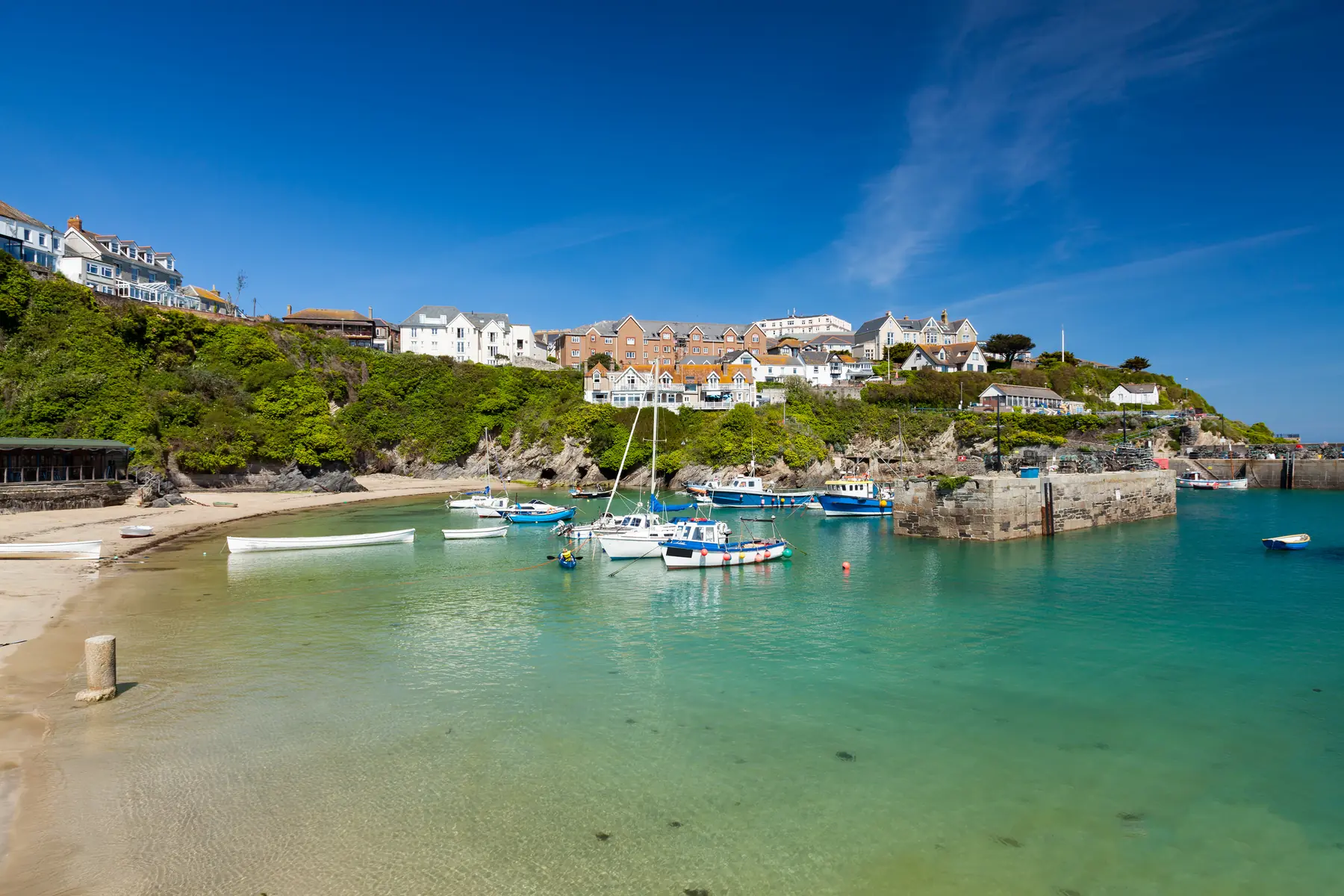
Newquay is famous for beaches, and the harbour is the thing those beaches were built around. It sits in a small, three-pier cove under the town, Towan on one side, Towan Head on the other, and a fleet that still goes out. Cornwall Harbours call it a fishing and pleasure harbour: tidal moorings, seasonal trip boats, and all-year fishing vessels. It is the largest landing place for shellfish on the north Cornish coast. It is not a paddling beach.
Come to look. Come to eat what came in. Leave the sand for Towan.
The site is small — about three acres, harbour orders from the 1830s, a harbour of some sort here since the fifteenth century — and it is busy in a way a postcard does not show. Larger boats work pots for lobster and brown crab; smaller boats handline for mackerel and pollack. Fish is landed, iced, and sent on. There is an ice plant, a slipway, a rowing club and, around the quay, the kiosks that make a visitor harbour out of a fishing one.
Pleasure and work share the same water. Trip boats and mackerel sessions leave from South Quay. Pilot gigs come in and out from the rowing club. None of that is a swimming area. The inner harbour dries; boats sit on the sand at low water and float on the flood. If you want to swim, Towan is twenty metres sideways.
The harbour is under the town, which means a hill. From Fore Street, South Quay Hill drops to the quay. From Towan, at mid to low tide, steps and a rock crossing link the beach to the harbour wall; the rocks are slippery, and at high water that route disappears.
There is a Cornwall Council long-stay on the harbour itself, TR7 1HR, with a handful of spaces. It is not a plan after breakfast. Park at The Manor or use the summer park and ride, and walk. The parking guide is the rest of that decision. If stairs are a problem, the view from the road above is the visit.
This is a tidal harbour on a coast with a large range. Low water leaves boats on the sand and trip boats waiting for enough to float.
Two practical consequences. First, boats leave and land on the tide, not on your timetable. Ask on the quay that morning; the skippers are the authority, not a screenshot. Second, the walk between harbour and Towan is tide-dependent. At low water you pick your way over the rocks; at high water you go up through the town and down the hill. The same tide decides whether Towan is a wide beach with a pool in it or a strip under the wall. Combine the two only after you have looked at a tide table.
Stand on South Quay in the morning and the harbour is still itself: pots, ice, someone washing down a deck. Cornwall Harbours have described a fleet of around twenty boats, five to ten metres, and the largest shellfish landings on this coast.
What a visitor actually does with that: look, keep clear of working gear, and eat nearby. There are stalls on the quay when the season supports them. The harbour end of the eating map is the one that still tastes of the boats — see where to eat.
Trip boats — mackerel sessions, fishing trips, wildlife runs — leave when the sea and the tide allow. Wind cancels more of them than rain does. Book on the quay; do not assume a winter timetable. Gig racing is free to watch from the wall on summer race days.
Towan is the beach the harbour spills onto, and it is the reason to combine the two. It is the most sheltered of the town beaches, with a tidal pool at low water and, on the rock in the bay, the house on an island. The Blue Reef Aquarium sits on the promenade above the sand. At low tide Towan joins Great Western and Tolcarne. Our beaches article has the full run.
Do not confuse the harbour wall with the beach. The wall is for walking and watching. The sand is for sitting.
From the north quay and from the west end of Towan you see the thing everyone photographs: a house on a rock in the bay, joined to the mainland by a private suspension bridge. The island is Jago’s Island; the house is someone’s home. You look at it. You do not walk over.
At high water the rock is an island. At low water the sand comes up around it. It is the oddest building in Newquay and it belongs on this page rather than on a Fistral one. Keep off the rocks around it when the tide is making.
South Quay is the working and visitor side: trip-boat kiosks, the rowing club, the hill down from town. North Quay is the outer arm, a walk with a rail and a view back into the cove.
Stay off working gear. Pots, ice, ladders and boats being loaded are not climbing frames. Do not swim in the harbour — Towan is the swimming beach. Watch your feet on the steps and the rock crossing. Keep dogs on a lead on the quay. Fishing from South Quay is a local habit around high water; do not cast across a gig or a trip boat that is coming in.
Treat the place as a workplace that happens to be beautiful. The byelaws sit with Cornwall Harbours.
The shape that works: down to the harbour first, while the boats are moving. Then across to Towan as the tide drops, the aquarium if the weather turns, and along the sand to Great Western at low water. Back up the cliff when you are done, not by relocating the car. None of it requires Fistral. The surf beach is a different outing, on the other side of Towan Head.
A wet version swaps the sand for the aquarium and a harbour pub. The cove is more itself in a blow than in August sunshine. See Newquay in the rain.
Early on a working morning, for the fleet rather than the ice cream.
Low tide, if the point is to walk to Towan over the rocks and see the harbour dry.
High tide, if the point is boats moving, trip boats leaving, and the island actually an island.
A race evening, if the gigs are out.
September, when the town has thinned and the harbour has not.
The Newquay Fish Festival, usually in early September, is the one weekend the quay becomes a stage. Dates move; look at the local listings for the year you are in rather than a date copied forward. It is worth being here for, and it is not a quiet harbour morning.
Winter storms make the cove a spectator sport from the wall and from Towan Head, at a sensible distance from the edge. Do not stand on the seaward end of the pier when the sea is coming over it.
Cornwall Harbours run the port. Tide tables are essential for the rock crossing or a boat. Food on the quay is seasonal and small; the town is five minutes up the hill. Without a car this is one of the easier visits: the station is a short walk, and the harbour is downhill. See Newquay without a car.
The harbour is the reason there is a town here at all. The beaches made it a resort. You can do the harbour and Towan in an hour if you pick the tide, and you should.